Medium: Oil on canvas
Dimensions: 61 x 80 cm
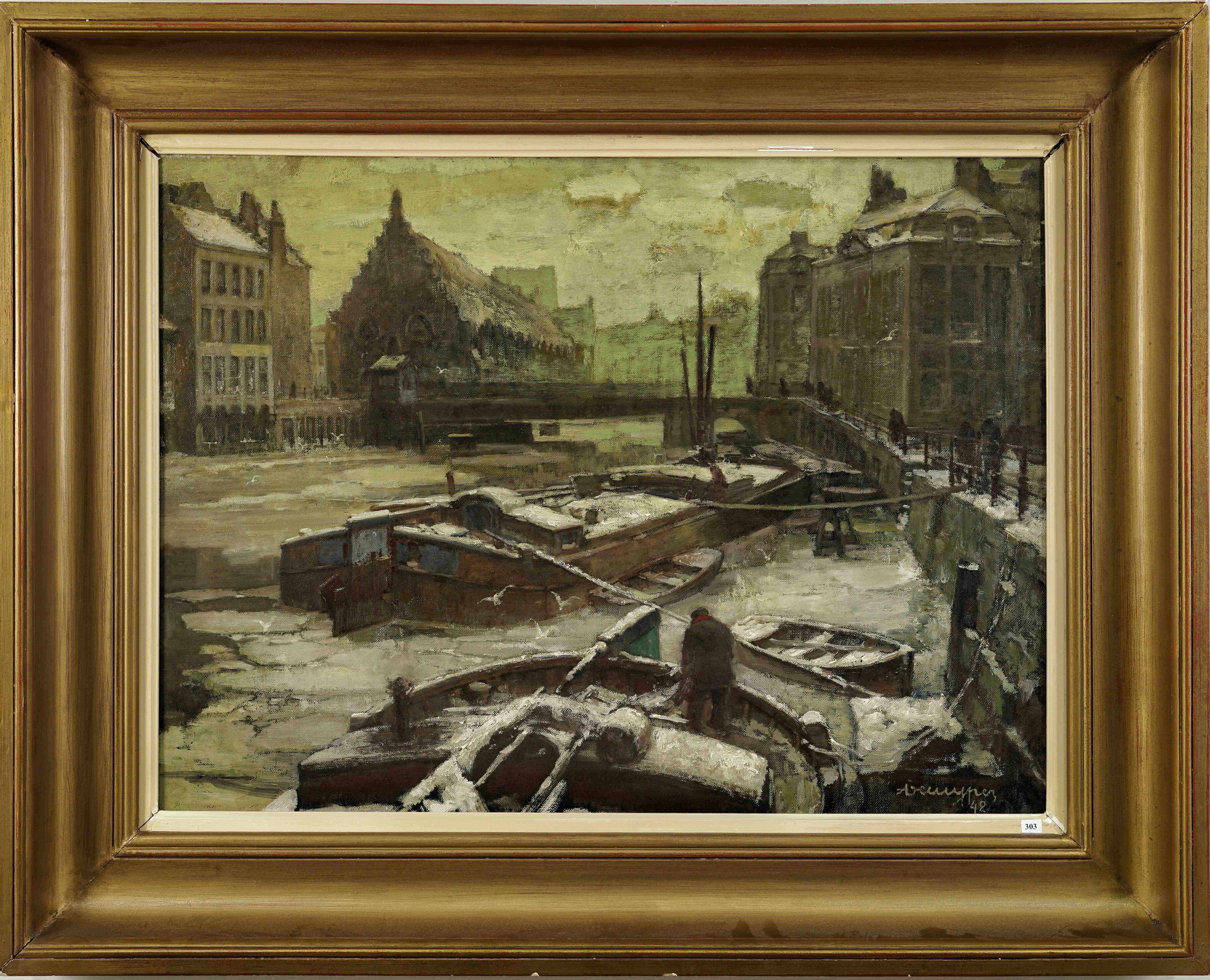
Signature: Signed lower right "A. Cuyper 42";
countersigned reverse side "A. De Cuyper"
Period of execution: c. 1887-1950
Price: ¥ 36,200
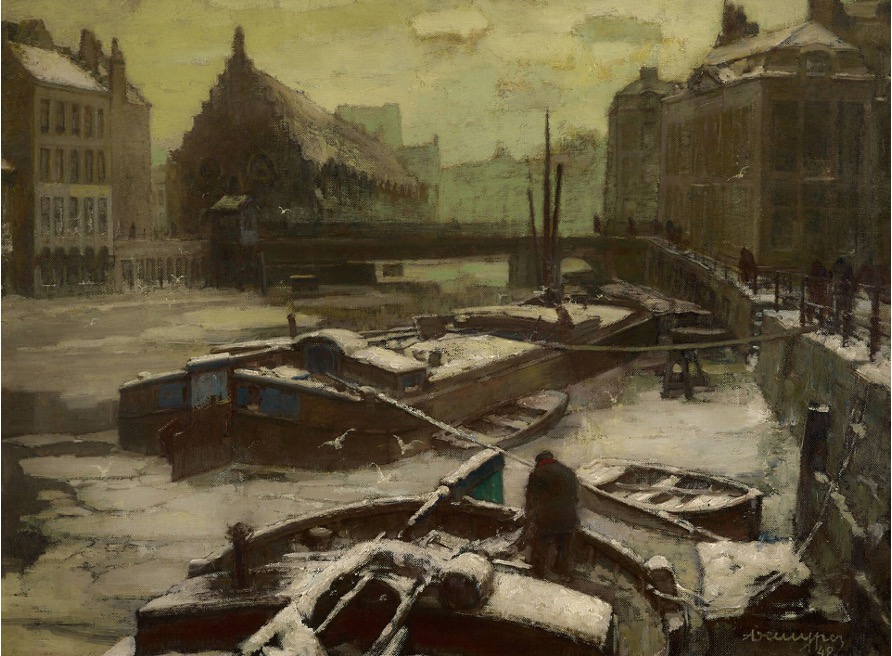
This painting depicts a winter canal in Ghent, with a moored barge occupying the foreground and drawing the eye towards the bridge and buildings beyond. The arrangement of boat, canal, and architecture creates a clear sense of recession, while the heavy application of paint gives the scene a strong physical presence.
Cuyper pays particular attention to the texture of snow. Thick passages of white paint gather along the boat, bridge, and pavement, contrasting with the maroons, browns, and ochres that structure the composition. The brightest whites are concentrated in the foreground, while the snow becomes softer and greyer towards the distance, where the paint is applied more fluidly. This gradual change in tone helps lead the eye through the cityscape and reinforces the damp, overcast atmosphere of winter. The restricted palette shows an affinity with Vincent van Gogh’s early Dutch paintings, particularly The Parsonage Garden at Nuenen in Spring (1884), in the collection of the Groninger Museum (Fig. 1). Both artists work with a broad range of ochres, earthy browns, and subdued greens, using relatively limited colour to create considerable tonal variation. In Van Gogh’s early work, these darker colours reflect his engagement with the Dutch painting tradition and with artists such as Rembrandt, whose handling of warm browns and strong tonal contrasts remained an important reference for nineteenth-century Dutch painters. Cuyper adopts a similarly earthy foundation but introduces cooler green-grey tones that give the winter scene a more modern character. The sky and distant architecture are treated with flatter, looser strokes, allowing forms to soften gradually into the atmosphere. Against this subdued background, the thicker snow and darker outlines of the barge become especially prominent. Through this combination of restrained colour, visible impasto, and changing paint texture, Cuyper captures both the physical character of snow and the diffused light of a northern European winter. The result combines the tonal tradition of nineteenth-century Dutch painting with a freer, more modern approach to surface and atmosphere.

Alfons De Cuyper, born in 1877 in Sint-Niklaas and died in Ghent in 1954, studied at the Higher Institute in Antwerp, focusing on sculpture (1903-1906) and painting (1907). From 1909 onwards, he taught sculpture and direct carving at the Antwerp Technical School. At the Triennial Exhibition of the Royal Society for the Promotion of Fine Arts in Antwerp, he exhibited Oedipus in 1911, A Man's Torso and A Child's Head in 1926, and Oedipus and a Portrait at the Liège Exhibition in 1924. In 1901, he designed the tomb monument for Madeleine Jeanne Fernande Baetens at the Uccle Père Lachaise (Brussels Cemetery). At the Art Competitions of the 1920 Antwerp Olympic Games, he won a bronze medal for the following sculptures: Skua-Dater and Runner. De Cuyper aslo designed several war memorials, including those in Gistel, Aalst, Bree, and Heusden. In Antwerp (Burletstraat), he also designed the monument for the orphans of the boys' school.



 CN
CN