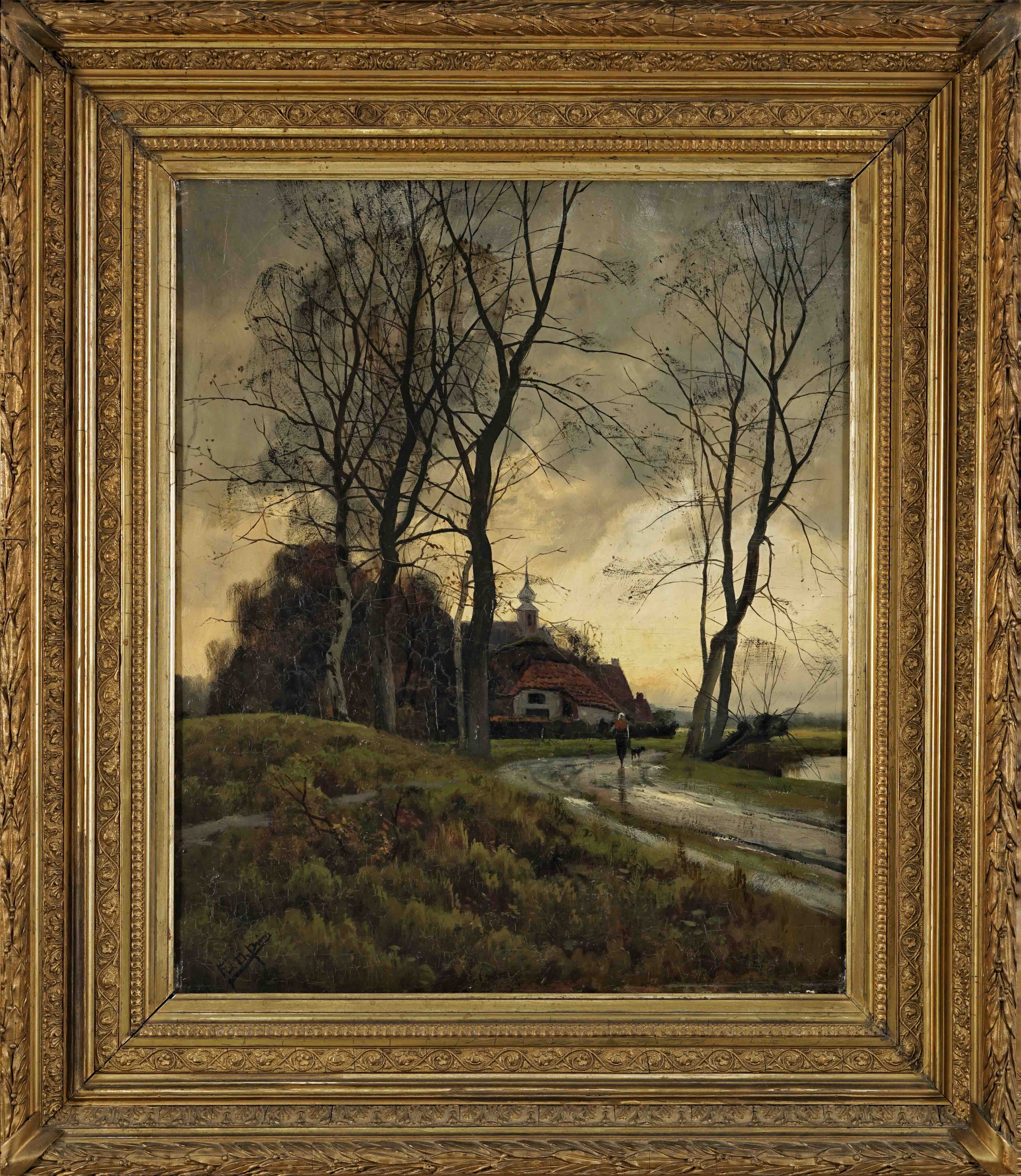
Medium: Oil on canvas
Dimensions: 60. 5 x 50 cm
Signature: Signed lower left
Period of execution: c. 1859-1908
Price: ¥ 29,400
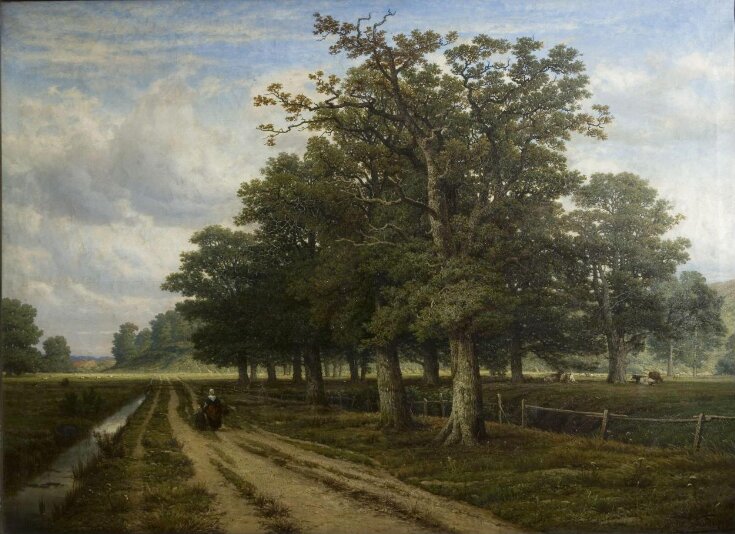
During his time at the School of Fine Arts in Antwerp, de Prins worked in the studios of Edward Dujardin (1817-1889), the landscape painter Johannes Emmanuel van den Busshe (1837-1908), Jozef van Luppen (1834-1891), and the watercolour painter and architect Auguste Schoy. The distinctly Flemish influence of his paintings is undeniable, as is the romantic sensibility that characterised his oeuvre. This landscape at dawn is a fine illustration of 19th-century Flemish painting, where the silhouette of tree branches brings the romantic touch that appealed so strongly to collectors of this period. Along the country footpath, the sun blazes as it disappears beyond the horizon. At the end of the road lies a red-bricked mansion, surrounded by a grove of trees that partially conceals a farmhouse with a sun-illuminated roof. A small figure, dressed in a white headpiece and red gilet, trots purposefully along, accompanied by a dog, toward the mansion. The plump silhouette rises against the glow of the setting sun, rendered with a foggy touch of orange against a smooth gradation from pale yellow to greyish blue. The egg white and cream tones are handled with delicacy, layered in scattered, thin applications to evoke the taste of sunlight just behind the clouds. Belgian artists in the late 19th century were continuously fascinated by the Romantic landscape featuring large trees and expanses of blue sky filled with cumulus clouds; a similar painterly quality and approach are frequently found in major collections around the world. A similar work by de Prins’ teacher, Joseph van Luppen, can now be found in the Victoria and Albert Museum, London (Fig. 1). Romantic artists like them were fascinated by nature, which they interpreted as a mirror of the mind. Through their paintings, they examined aspects of human nature, folk culture, national and ethnic origins, the remote, the mysterious and the occult.
Ferdinand de Prins (1859-1908) was a Belgian painter known for his romantic-style landscapes, harbour scenes, and animal paintings. Born in Brecht, Belgium, de Prins began his artistic training at a young age, studying decorative arts, design, and painting at the Antwerp Academy of Fine Arts, where Vincent van Gogh acquired his art training prior to his departure to France, becoming a real artist. He painted in a traditional Flemish romantic style, often featuring scenes from specific Belgian locations such as Borgerhout, Deurne, and Kontich. De Prins was a member of the "Eigen Vorming" art circle in Borgerhout, an influential association around the turn of the 19th and 20th centuries. The circle included artists such as Albert Baggen and Joseph Posenaer among its co-founders and members.



 CN
CN